

Climbing belay devices: Why and how should you use them?
- 10 min reading

Whether in the gym or on the crag, belaying a climber requires keeping your eyes looking up for several minutes at a time, which quickly leads to tension in the neck and upper back. It’s a discomfort that many climbers are familiar with.
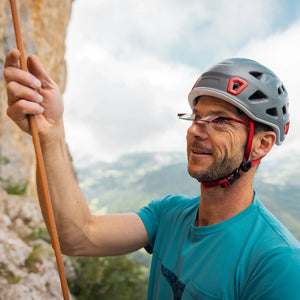
Belay goggles offer a simple and immediate solutionto this problem. Thanks to a prism system, they allow you to keep an eye on the climber without looking up, while maintaining a natural posture. The result: less fatigue, greater comfort, and better focus over time, especially during repeated attempts or long sessions on the crag.

When are safety goggles useful?
Belay goggles aren't just a gimmick. They quickly become essential whenever a belay session runs long.
They are particularly useful while climbing, when the climber is several meters off the ground and belaying is no longer necessary. From that point on, you spend most of your time looking up, often without moving.
They really come into their own:
- when your partner is climbing a route
- during long indoor sessions
- on cliffs, on long or challenging routes
- when you regularly belay multiple climbers

The longer the belay lasts, the more obvious the increase in comfort becomes. And with it comes a greater ability to stay focused and not look away, even for a millisecond.
How do you use a safety harness correctly?
Belay glasses are easy to use, but like any piece of equipment, they require a few adjustments to be fully effective.
When to wear them
Goggles should not be worn during the climb. As long as the climber is close to the ground, it is essential to maintain a clear, unobstructed view of the surroundings.
In those cases, you can keep your goggles on: on your head, lower on your nose so you can quickly push them back up, or in the cases designed for that purpose. Some attach to your harness and have a controlled opening that lets you have them within reach whenever you need them.

Next, you can put on the belay device once the climber has reached a sufficient height—usually starting from the second quickdraw. At that point, the belay becomes more static, and the belay device really comes into its own.
How to wear them
Belay goggles are worn just like a pair of regular glasses. They must sit securely on your nose so that the lenses are aligned with your field of vision. Some models have adjustable nose pads; be sure to adjust them to fit your nose properly so that the goggles stay in place and don’t shift while you’re belaying.

Depending on the model, they can be used:
- only
- over prescription glasses or sunglasses
- attached directly to your frame in the case of certain models
The goal is to maintain a clear view of the climber without having to adjust your posture. So be sure to adjust your goggles properly and fit them to your face to ensure stability and comfort throughout the entire belay.
Good habits to keep
Even when wearing belay glasses, it’s important to maintain good habits to ensure the safety of the climber you’re belaying.
You should continue to:
- keep an eye on your surroundings
- Check your belay system regularly
- keep an eye on the big picture, rather than focusing solely on the climber
Goggles are a safety aid, not a substitute for basic safety precautions.
Climbing goggles for indoor or outdoor climbing: should you use them in both situations?
People often associate belay glasses with rock climbing. However, they’re just as useful indoors because you’re performing the same movement.
When climbing indoors, you’re often right up against the wall, with no way to step back. The strain on your neck can beeven more intense. Plus, repeated climbs and long sessions can cause significant neck fatigue.
Outdoors, routes are often longer, and the conditions (light, position, terrain) makebelaying even more challenging.
In both cases, the goggles make the experience more comfortable and seamless. They quickly become second nature, no matter where you practice.
Want to try out safety goggles without spending too much?
If you want to try out safety goggles without spending a lot of money, a simple yet effective model is often the best choice. This lets you see over time how well they fit you, as well as evaluate other factors when choosing your next pair: weight, materials, lens size, etc.

The Plasfun First is perfect for this purpose. It focuses on the essentials: clear visibility, ease of use, and immediate comfort—with no unnecessary frills—so you can experience the sensations, develop the right reflexes, and make belaying accessible to everyone.
You climb regularly and want more comfort
For more regular use, comfort becomes a key factor. Whether you’re doing a full session or your partner is taking one shot after another, every detail matters: field of view, smooth operation, and ease of storage.

This is where more advanced models really come into their own. A wider field of view, a practical case, and easy handling—all these features make for a more enjoyable everyday experience. The Plasfun Evo follows this philosophy, featuring a sportier design, available in three colors, and optimized visual comfort to support more frequent use.
Are you looking for a durable and adjustable model?
If you climb regularly, whether at the gym or on the crag, you’ll soon find yourself looking for gear that’s built to last and fits your body perfectly.

Comfort is no longer just about vision, but also about fit, material quality, and the overall feel when worn. Some climbers prefer to invest directly in a more advanced model designed for heavy use. Take the Y&Y Classic, for example, which features an adjustable frame —both in the temples and the side arms— offering exceptional durability and a true sense of stability while belaying.
Do you already wear prescription glasses or sunglasses?
If you already wear glasses, some options are better suited than others. It’s not just a matter of neck comfort anymore, but also of compatibility with your everyday gear. Wearing multiple frames at once can quickly become uncomfortable, especially outdoors.

In this case, there are specific solutions designed to fit your needs without compromise. Instead of adding an extra pair, you can integrate the prisms directly into your glasses. You can choose our Clip Up model: a simple, discreet system that attaches to your frames and can be easily raised as needed.*
The YY Vertical Extra
How to Choose the Right Climbing Goggles for Your Activity
The choice depends mainly on how you plan to use it and your specific needs.
If you're just starting out or simply want to improve your comfort, a simple, affordable model will be more than enough. If you ride regularly, you might want to consider a model that offers a wider field of vision and greater practicality for everyday use.
Finally, for intensive or long-term use, opt for durable materials and a good fit. And if you wear glasses, compatibility becomes a key factor in your choice.
The key is to choose a model that suits your needs so you can really benefit from it.
Mistakes to Avoid When Using Safety Glasses
Like any piece of equipment, belay glasses can be used incorrectly if certain guidelines are not followed.
The first mistake is to use them during the parade. This limits your field of vision and can compromise safety.
It is also important not to rely solely on the prisms. Belaying requires constant attention to the environment, the system, and the climber.
Choosing a model that isn't suited to your needs can also limit the product's value. A model that's too technical for occasional use—or, conversely, too basic for intensive use—won't fully meet your needs.
Finally, maintenance is often overlooked. Scratched or dirty lenses can impair your vision. Regular cleaning with a suitable cloth and taking special care when handling and storing your glasses in their case will help maintain good visual quality for longer.
In conclusion
Climbing belay goggles are a simple yet highly effective accessory for improving comfort and the quality of belaying. By reducing neck strain, they help you stay more alert and fully enjoy every climbing session, whether indoors or on the crag.
When chosen and used properly, they quickly become an indispensable habit.
What's new?

New
24.90 €

New
Boulder Chalk Bag
Bouldering chalk Bag
37.90 €


New
Patented Product
SandwichBase climbing hangboards support
The smart, stable support for your hangboard - no holes, no tools.
4.85
(13 notice)
189.00 €
New
29.90 €

New
Climbing Mug Evo | Design Simon Favrot
EVO Mug - Design mug with climbing grip shapé by Simon Favrot: 3 models, 1 playful challenge, 100% climbing & style
5.0
(15 notice)
25.90 €

New
KeyHolder mountain edition wall-mounted key ring
Wooden wall key ring inspired by the great summits
5.0
(5 notice)
59.90 €